
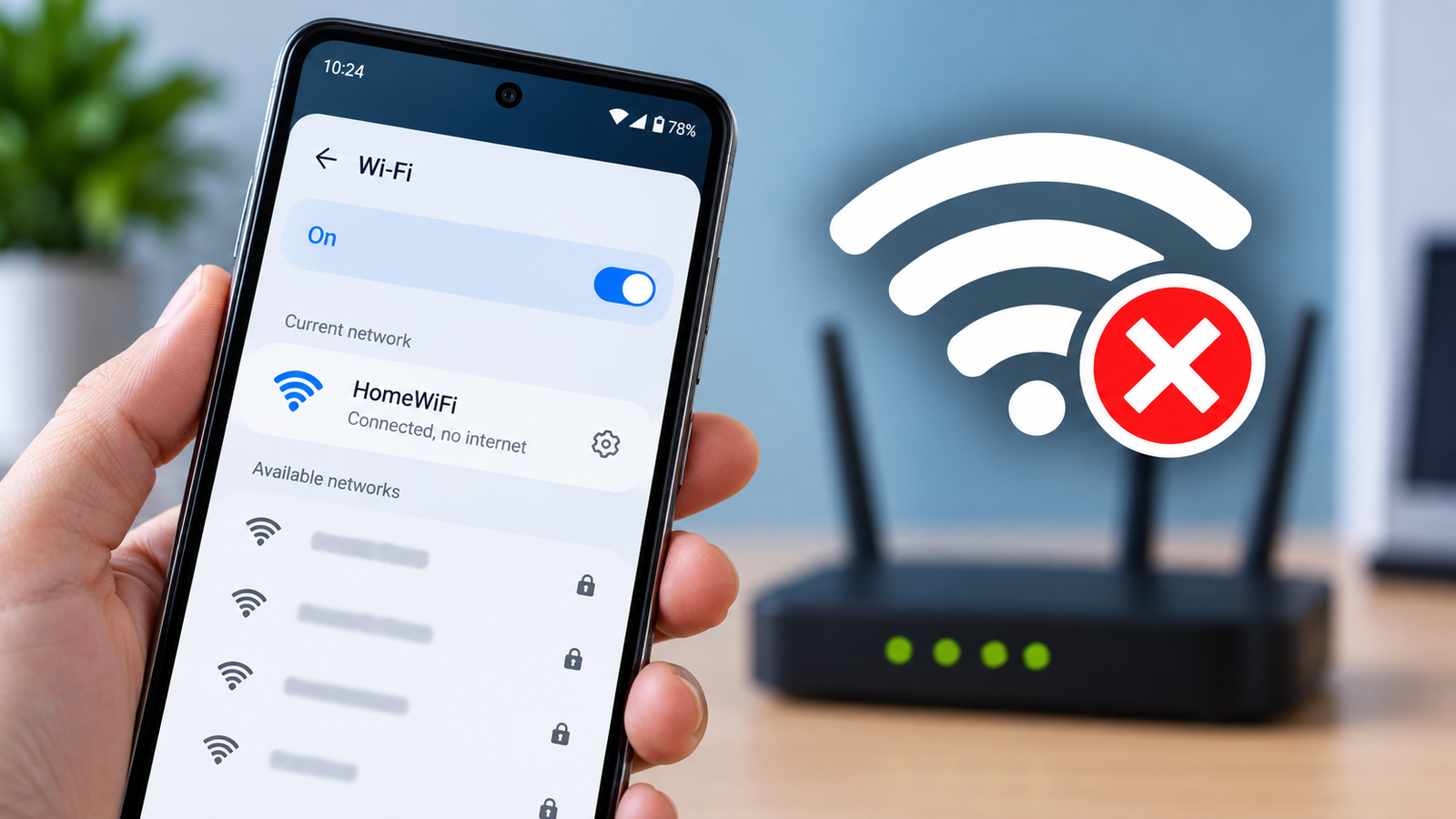
Your Android phone may sometimes show that it is connected to Wi-Fi, but websites, apps, and online services still refuse to load.
This problem can be frustrating because the Wi-Fi icon looks normal, yet there is no actual internet connection.
The issue can come from your phone, router, network settings, DNS configuration, or even your internet service provider.
The good news is that most Wi-Fi problems on Android can be fixed with a few simple steps.
Here is what to try.
Why Is My Android Connected to Wi-Fi but Has No Internet?
If your Android phone is connected to Wi-Fi but has no internet, the connection between your phone and the router may be working while the router itself is not reaching the internet.
Common causes include:
- Router or modem problems
- Temporary network errors
- Incorrect IP settings
- DNS problems
- VPN interference
- Outdated Android software
- Network authentication issues
- Weak or unstable Wi-Fi signal
- Problems with your internet provider
The fastest way to fix the issue is to start with the simplest steps first.
1. Turn Wi-Fi Off and Back On
Start by refreshing the Wi-Fi connection.
On your Android phone:
- Swipe down from the top of the screen.
- Tap the Wi-Fi icon to turn it off.
- Wait about 10 seconds.
- Turn Wi-Fi back on.
Then try opening a website or app again.
This simple step can fix temporary connection problems.
2. Turn Airplane Mode On and Off
Airplane Mode can refresh your phone’s wireless connections.
To try it:
- Swipe down to open Quick Settings.
- Turn on Airplane Mode.
- Wait about 10 to 15 seconds.
- Turn Airplane Mode off.
Reconnect to Wi-Fi and check whether the internet is working.
3. Restart Your Android Phone
A temporary software issue can sometimes prevent Android from accessing the internet correctly.
Restarting the phone can clear these temporary problems.
Press and hold the power button, then choose:
Restart
After the phone turns back on, reconnect to Wi-Fi and test the connection.
4. Restart Your Router
If your phone connects to Wi-Fi but cannot access the internet, the router may be the real problem.
Restart your router:
- Unplug the router from power.
- Wait about 30 seconds.
- Plug it back in.
- Wait a few minutes for the connection to return.
Then reconnect your Android phone.
If other devices also have no internet, the problem is likely with the router or internet connection rather than your phone.
5. Forget the Wi-Fi Network and Reconnect
Your phone may have saved incorrect network information.
Removing and reconnecting to the network can help.
Open:
Settings → Network & internet → Internet
or:
Settings → Wi-Fi
The exact menu name can vary depending on your Android phone.
Tap your Wi-Fi network and choose:
Forget
Then reconnect to the network and enter the Wi-Fi password again.
6. Check Whether Other Devices Have Internet
Before changing more settings, test the same Wi-Fi network on another device.
Try using:
- Another phone
- A laptop
- A tablet
- A smart TV
If no devices can access the internet, the issue is probably related to:
- The router
- The modem
- Your internet provider
If other devices work normally but your Android phone does not, continue troubleshooting the phone.
7. Move Closer to the Router
A weak Wi-Fi signal can sometimes allow your phone to stay connected without providing a stable internet connection.
Move closer to the router and try again.
Also check whether walls, furniture, or electronic devices are interfering with the signal.
If the internet starts working closer to the router, signal strength may be the problem.
8. Disable VPN Temporarily
A VPN can sometimes interfere with your internet connection.
If you use a VPN, temporarily disconnect it.
Then open a website or app again.
If the internet works after disabling the VPN, the VPN server or configuration may be causing the problem.
You can try reconnecting to a different VPN server later.
9. Turn Off Private DNS Temporarily
Android includes a Private DNS feature that can affect internet connectivity if it is configured incorrectly.
Open:
Settings → Network & internet → Private DNS
Depending on your device, the location of this setting may be slightly different.
Select:
Automatic
or temporarily choose:
Off
Then test your connection again.
If the internet starts working, your previous Private DNS provider may have been unavailable or incorrectly configured.
10. Check Date and Time Settings
Incorrect date and time settings can occasionally cause problems with secure websites and online services.
Open:
Settings → System → Date & time
Enable:
- Set time automatically
- Set time zone automatically
Then reconnect to Wi-Fi.
11. Disable Mobile Data Temporarily
In some cases, switching between Wi-Fi and mobile data can cause temporary connection confusion.
Turn off mobile data for a moment and test Wi-Fi by itself.
Swipe down from the top of the screen and disable:
Mobile data
Then open a website.
If Wi-Fi works correctly, you can turn mobile data back on afterward.
12. Check IP Settings
Most Wi-Fi networks should use automatic IP settings.
If your phone is configured with a static IP address incorrectly, the internet may not work.
Open your Wi-Fi network settings and look for:
IP settings
Make sure it is set to:
DHCP
instead of Static, unless your network specifically requires a manual configuration.
13. Reset Network Settings
If none of the previous steps work, resetting network settings can fix deeper Wi-Fi configuration problems.
On many Android phones, go to:
Settings → System → Reset options
Then choose something similar to:
Reset Wi-Fi, mobile & Bluetooth
The wording may vary by phone manufacturer.
This reset can remove:
- Saved Wi-Fi networks
- Bluetooth connections
- Network preferences
You will need to reconnect to your Wi-Fi networks afterward.
14. Update Android
Software updates can include bug fixes for Wi-Fi, security, and network connectivity.
Check for updates by opening:
Settings → System → Software update
or:
Settings → Software update
Install any available updates and restart your phone.
15. Check for a Wi-Fi Sign-In Page
Some public Wi-Fi networks require you to sign in before accessing the internet.
This is common in:
- Hotels
- Airports
- Cafes
- Shopping centers
- Schools
Connect to the Wi-Fi network and open your browser.
Try visiting any website.
A sign-in page may appear automatically.
If it does, complete the login or accept the network terms.
16. Check Your Internet Provider
If all devices connected to your Wi-Fi have no internet, your internet service may be temporarily unavailable.
Check your modem or router for warning lights.
You can also contact your internet provider to find out whether there is an outage in your area.
If the issue started suddenly and nothing has changed on your phone, an ISP outage is possible.
Why Does Wi-Fi Say Connected Without Internet?
Wi-Fi and internet access are not exactly the same thing.
Your Android phone can successfully connect to your router even when the router itself cannot connect to the internet.
That is why Android may show a Wi-Fi connection while apps and websites still fail to load.
Think of it as two separate connections:
Phone → Router
and:
Router → Internet
The first connection can work even when the second one does not.
Should You Reset the Router?
Restarting the router is safe and should usually be tried before resetting it.
A full router reset is different.
Resetting the router to factory settings can erase:
- Wi-Fi network names
- Wi-Fi passwords
- Internet settings
- Custom router settings
Do not perform a factory reset unless you know how to set the router up again.
What If Only One App Has No Internet?
If Wi-Fi works in your browser but one specific app cannot connect, the problem may be with that app rather than Wi-Fi.
Try:
- Closing the app.
- Opening it again.
- Updating the app.
- Restarting your phone.
You can also clear the app’s cache from Android settings if necessary.
If every other app works normally, there is usually no need to reset your Wi-Fi settings.
Final Thoughts
If your Android phone is connected to Wi-Fi but has no internet, start by restarting Wi-Fi, your phone, and your router.
Then try forgetting the network, disabling VPN or Private DNS, checking IP settings, and resetting network settings if necessary.
If other devices also cannot access the internet, the problem is more likely related to the router or your internet provider.
In most cases, one of these steps should restore your connection without requiring a factory reset.
FAQ
Why does my phone say connected to Wi-Fi but no internet?
Your phone may be connected to the router, but the router may not have an active internet connection. Network settings, DNS problems, or router issues can also cause this message.
Will forgetting Wi-Fi delete my data?
No. Forgetting a Wi-Fi network only removes the saved network and password from your phone. It does not delete photos, apps, or personal files.
Does resetting network settings delete photos?
No. A network reset normally removes Wi-Fi, Bluetooth, and network preferences but does not erase your personal files.
Why does Wi-Fi work on other devices but not my Android phone?
The issue may be caused by your phone’s saved Wi-Fi configuration, VPN, DNS settings, or another network setting.
Should I factory reset my Android phone?
A factory reset should be a last resort. Try restarting the phone, resetting network settings, and checking the router first.